Every evening after dinner, Nino left his toys scattered on the rug: blocks, pencils, shells, toy cars, pieces of cloth, and a little horse missing a wheel.
“Put things away,” said his mother.
“Later.”
But later came sleep, and the toys stayed there.
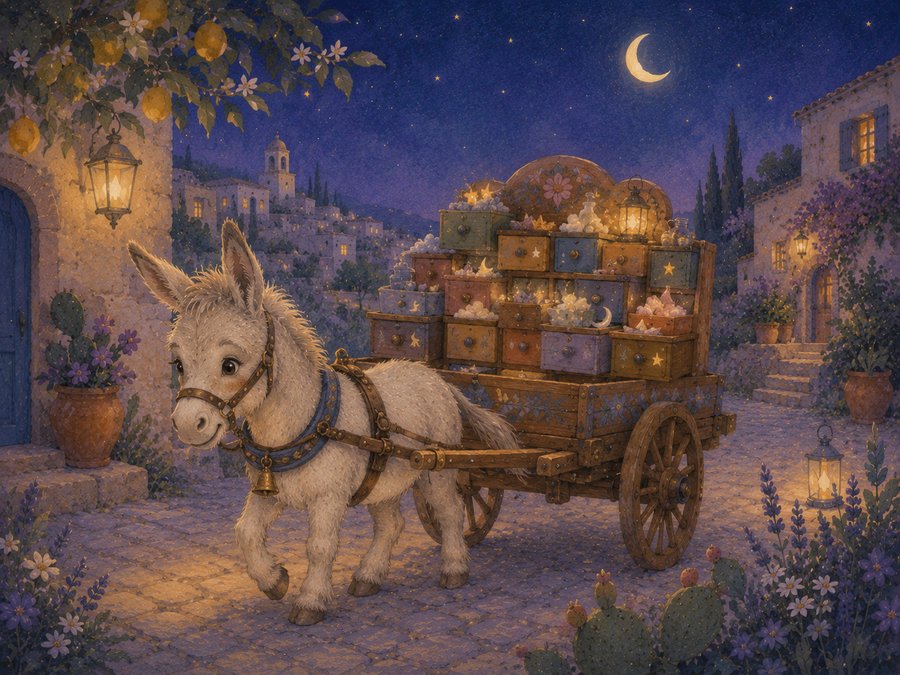
One night Nino heard a creak beneath the window. He looked out and saw a small Sicilian cart, painted red, yellow, and blue. It was not pulled by a horse. It moved by itself.
On its side was written: “Lost Dreams.”
“Who are you?” asked Nino.
“I collect the dreams that children cannot find again because they remain mixed up in disorder,” answered the cart.
Nino came down in his pyjamas.
The cart entered the room. Every object on the rug cast a dream: the shell showed the sea, the blocks a castle, the pencil a coloured road, the little horse a race in the wind.
But the dreams were all tangled together. The castle ended up in the sea, the road passed over the horse, the shell was looking for the pencil sharpener.
“They are confused,” said Nino.
“They are not ugly. They simply need a place.”
The cart opened little drawers.
“Where shall we put the sea?”
Nino took the shell and placed it in the blue box.
“And the colours?”
In the jar.
“And the blocks?”
In the wooden basket.
Every time an object found its place, the dream became clearer. The castle returned to being a castle. The sea returned to being the sea. The little horse had a road all its own.
Nino did not make perfect order. He made understandable order.
At the end, the rug was free. The cart made a slow turn around the room.
“Now the dreams know where to sleep.”
Nino yawned. “And tomorrow I will find them again?”
“That is exactly why.”
The next morning, as soon as he woke up, he found the shell in the blue box. He picked it up and remembered the dream of the sea.
From then on, tidying no longer seemed like a punishment. It was a way of giving things a home.
And every evening, when he put away toys and colours, he seemed to hear a cheerful creak in the distance: the cart of tidy dreams was passing down another street, looking for children who had forgotten where their wonders slept.