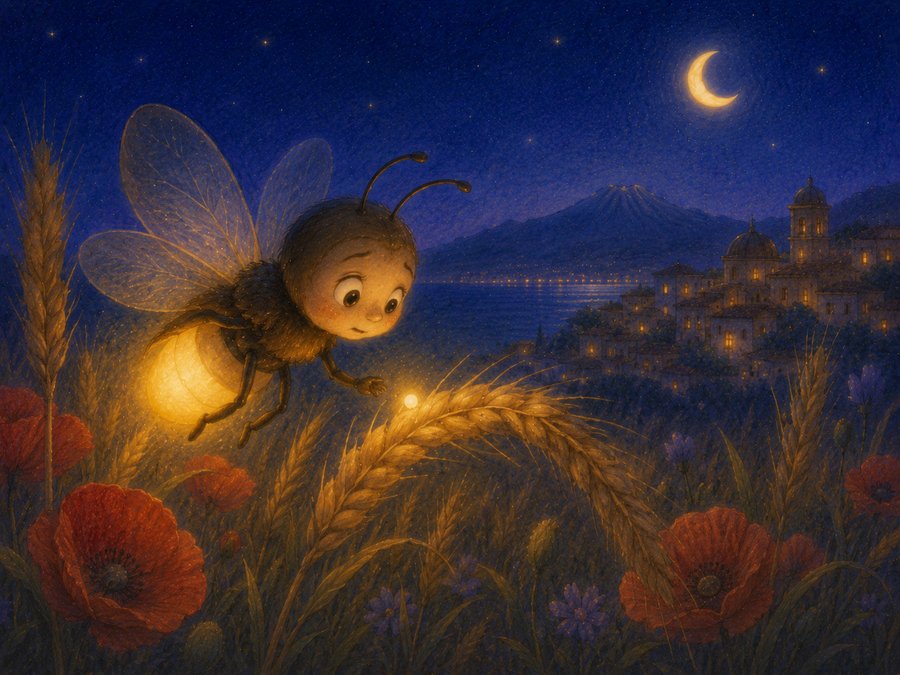
Lulù was a firefly with a dot of light at the end of her body.
It was not the largest in the field, but it was hers. Every evening she turned it on among the wheat and poppies, drawing small patterns in the air.
One night, while she was playing at making spirals, the dot fell.
Plip.
It landed on an ear of wheat.
Lulù looked at her dark tail and felt empty.
“I am no longer a firefly.”
The cricket heard her.
“You are Lulù.”
“But I do not shine.”
“Not right now.”
Lulù searched for the dot among the ears of wheat, but there were a thousand reflections: Moon, dew, insect eyes, pale petals. She grew tired and sat down.
A ladybird came close.
“Will you help me find the way?”
“I cannot. I am dark.”
“But you have eyes.”
Lulù looked. Even without her light, she could see the path between the wheat. She accompanied the ladybird to a safe leaf.
Then she helped an ant avoid a drop. Then she listened to a tiny gnat who was afraid of the dark.
With every gesture, Lulù’s tail grew a little warmer.
It was not shining yet, but it was not empty.
At last she found the dot on the wheat. She took it back gently. When she fixed it in place, the light returned, but different: softer.
Lulù understood that her worth had not been locked inside that dot. The dot was beautiful, yes. But even in the dark she had eyes, care, voice, presence.
From then on she shone without being afraid of shining less.
Because she knew she was Lulù even on nights without light.