Livia did not want to take a nap.
“I am not little,” she said.
But after lunch she yawned, rubbed her eyes, and got angry with the blocks when they fell.
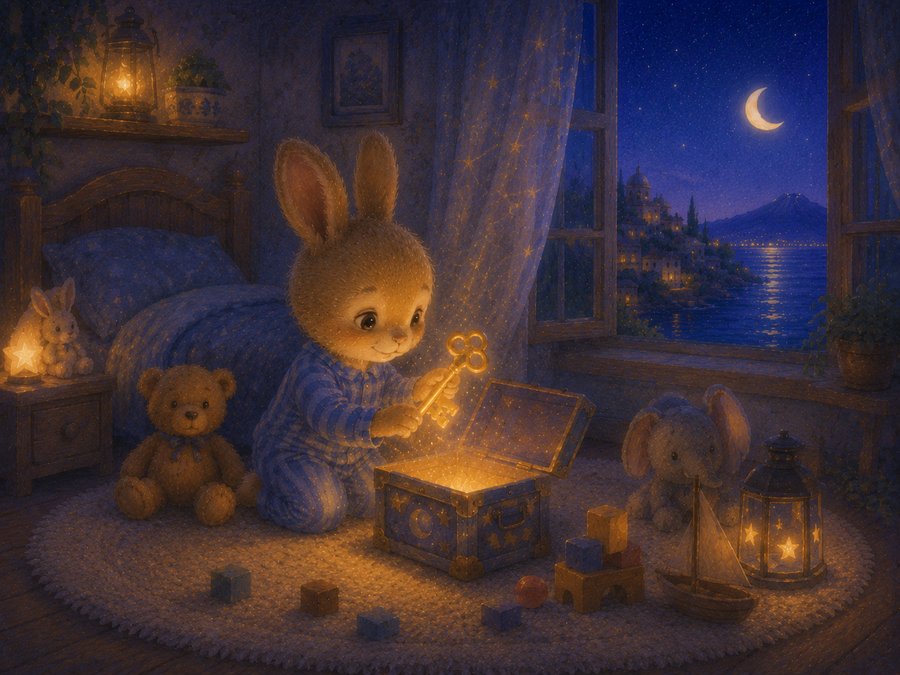
Her bedroom had a soft rug, a low shelf, and a honey-coloured curtain. One afternoon, on the pillow, she found a golden key.
It was not large. It was shaped like a leaf and had a little star-shaped hole.
“Mum, I found a key.”
Her mother looked at it. “Perhaps it opens the nap.”
“Naps do not have doors.”
“Not all doors can be seen.”
Livia tried the key in the wardrobe. Nothing. In the drawer. Nothing. In the toy box. Nothing.
Then she heard a small click when she brought it near the silence.
Not an empty silence. A silence made of gestures: putting the blocks in the basket, choosing a book, pulling the curtain, taking off her shoes, arranging the pillow.
Every gesture made the key shine.
Livia understood that she did not have to wait for Mum to prepare everything. She could do it herself.
She put the blocks away. Click.
She chose a book with a Moon. Click.
She pulled the curtain until it left only one line of light. Click.
She placed her shoes side by side. Click.
Finally she lay down.
The golden key did not open a door in the wall. It opened a door inside her: a quiet room where the body could rest.
Her mother came in softly.
“Did you do all this by yourself?”
Livia nodded, already half asleep.
“I am not little,” she whispered.
“No,” said her mother. “You are capable.”
From that day the key stayed on the bedside table. Sometimes Livia really took it. Sometimes it was enough to remember it.
When she felt her body tired, she no longer argued with the blocks. She looked for the small clicks: order, curtain, book, pillow, breath.
So the nap was no longer something imposed.
It was a door she knew how to open.