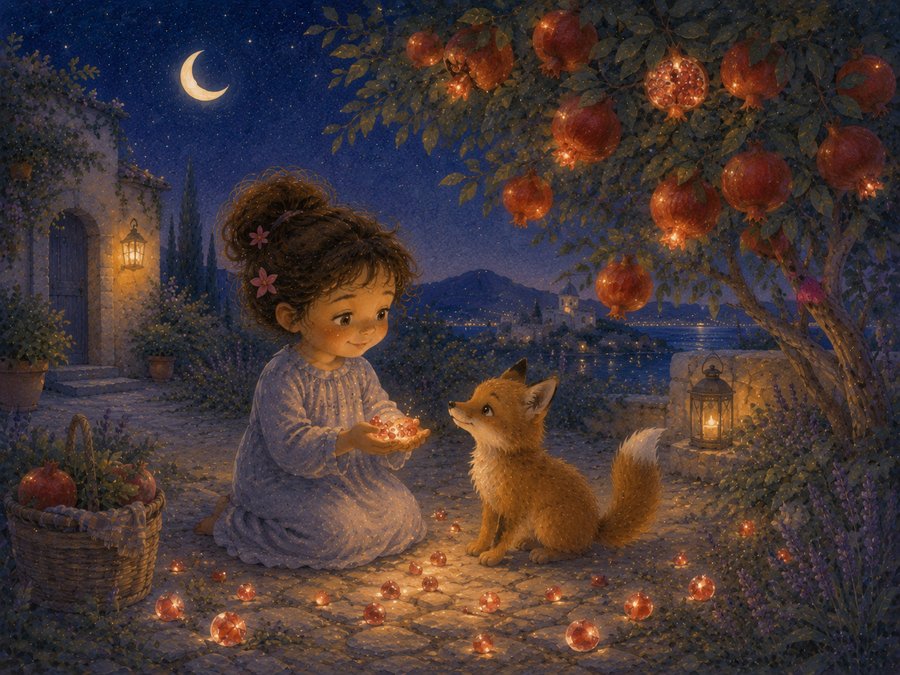
In the school garden there was a low pomegranate tree, with thin branches and red fruits that looked like little closed lanterns.
The children ran past it. Almost no one looked at it, except Sami, who liked stopping where others passed in a hurry.
One afternoon he saw an open fruit. Inside it, many red seeds shone.
“They look like rubies,” he said.
“They are thank-yous,” replied the pomegranate tree.
Sami stepped back. “Do pomegranate trees talk?”
“Only when someone looks slowly.”
A seed fell onto the warm stone. It did not roll away. It stayed there and made a small light.
“What would you like to say thank you for today?” asked the tree.
Sami thought of great things: a present, a party, a journey. But nothing came to mind.
“I don’t know.”
“Then look for something small.”
Sami looked around. The fountain had cool water. The teacher had smiled when he came in. Marco had lent him an eraser. His snack bread had been crunchy.
“Thank you for Marco’s eraser,” he said.
The seed shone.
Another seed fell.
“Thank you for the cool water.”
Another light.
Sami smiled. Little thank-yous were everywhere. They made no noise, but when he named them they became visible.
The next day he brought two classmates.
“You have to look slowly,” he explained.
At first they laughed. Then one said, “Thank you because today I did not lose my pencil.” A seed shone. The other said, “Thank you because Luca waited for me.” Another seed lit up.
Soon the stones beneath the pomegranate tree looked full of red fireflies.
The teacher noticed that the children argued a little less. Not because they had become perfect, but because they had learned to see good gestures before they disappeared.
At the end of autumn, the pomegranate tree lost its last fruits.
Sami was worried. “And now where do the thank-yous go?”
The tree rustled. “Into your hands.”
That day Sami lent his eraser to a younger child.
When the child said “thank you,” Sami felt a small light turn on inside him.
It was not a seed.
Or perhaps it was.