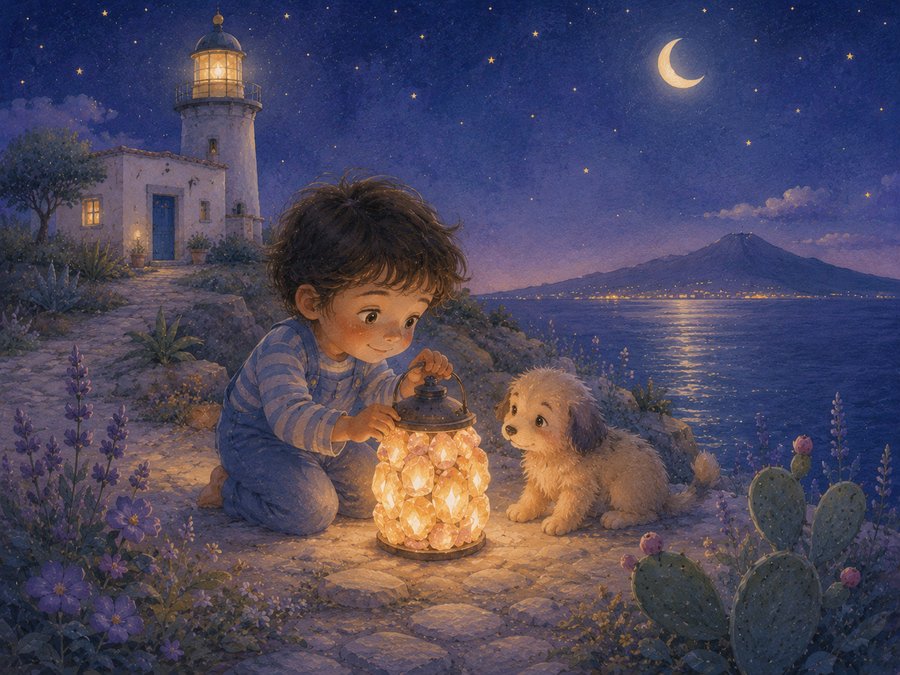
Above a white cliff, where the sea beat softly even when it seemed angry, there stood a little lighthouse.
It was not as tall as the important lighthouses marked on nautical maps. It had a blue door, a narrow stairway, and a round window facing the harbour. Its task was simple: every evening it had to turn on a light so the boats could find their way.
But the little lighthouse had a fear.
“I can see only one piece of sea,” it said to the Moon. “What if a boat is farther away? What if my light is not enough?”
The Moon did not answer at once. The Moon knows that certain questions need to breathe.
One windy evening, the keeper climbed up carrying a new lantern. It was not made of glass. It was made of sea salt, white and rough, with a small flame inside.
“This comes from the salt pans,” he said. “It does not make a large light. It makes a faithful light.”
The lighthouse did not understand.
As soon as the keeper went down, the lantern spoke.
“Good evening.”
“You can talk?”
“Only with those who are afraid of not being enough.”
The lighthouse blushed inside its stones.
“I am supposed to guide the boats, but the sea is enormous.”
The salt lantern trembled slightly. “Then let us begin with one boat.”
In the darkness a black dot appeared. A little boat was coming home slowly, pushed by a tired wind. The little lighthouse wanted to light everything: the whole sea, the far waves, the clouds, the harbour, the rocks. Its beam became restless and confused.
“Stop,” said the lantern. “Light the nearest rock.”
“Only that?”
“Only that.”
The lighthouse obeyed. The rock shone.
The little boat saw it and avoided the edge of the cliff.
“Now the stretch of water in front of the pier,” said the lantern.
The lighthouse moved its beam. The boat went on.
“Now the buoy.”
The buoy lit up like an orange in the dark.
Step after step, light after light, the little boat entered the harbour.
From the pier came a voice: “Thank you, little lighthouse!”
The lighthouse remained silent. It had not lit the whole sea. It had lit what was needed.
The salt lantern smiled with its flame.
“Trust is not knowing the entire road in advance. It is doing well the stretch that lies in front of you.”
In the evenings that followed, the lighthouse stopped straining itself. When the sea was dark, it no longer tried to defeat the darkness. It lit the rock, then the buoy, then the pier, then the window of the fisherman’s house.
Each light was small. Together, they became a return.
And the salt lantern, slowly wearing itself away, reminded the lighthouse that even a fragile light can guide someone, if it remains carefully lit.