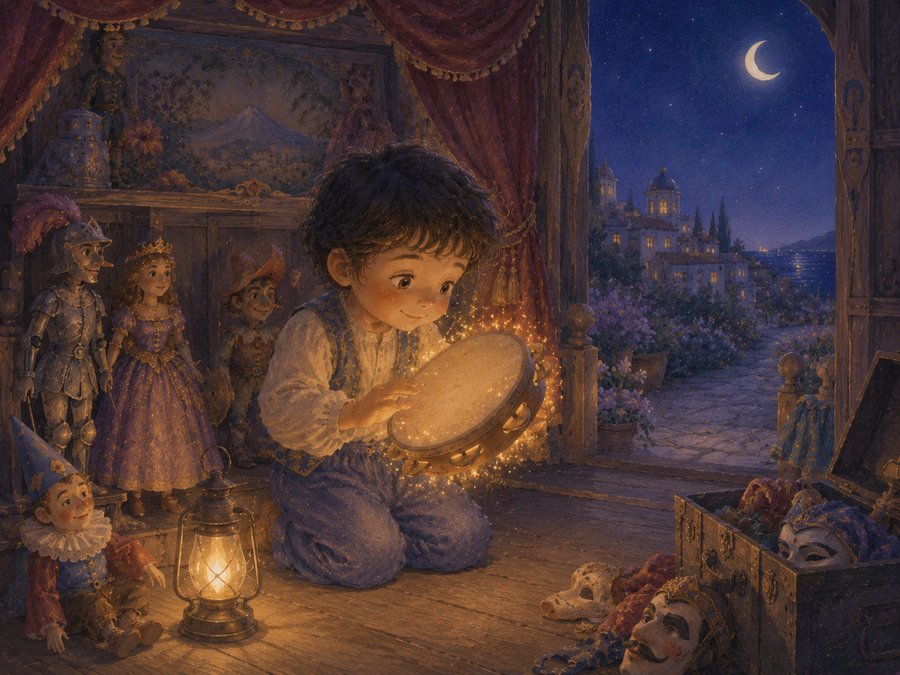
In the village theatre there was a small tambourine hanging behind the curtain. It had silver jingles and pale skin, but almost no one ever picked it up.
There were bigger drums, louder cymbals, brighter bells.
The tambourine sighed. “I play too softly.”
One night, when the theatre was closed and the puppets slept hanging from their strings, the tambourine tried to make itself heard.
Tin.
The sound was so light that it barely reached the floor.
The big drum laughed. “With that, you would not even wake a feather.”
The tambourine felt ashamed and stayed silent.
But from the row of puppets, a wooden princess spoke.
“I heard you.”
“Really?”
“Yes. Your sound is like a firefly.”
The tambourine trembled. “But in a show, strong sounds are needed.”
“Not always,” said the princess. “There are moments when the audience must bring its heart closer.”
The next evening there was a performance. Halfway through the story, the knight had to enter a cave to look for a lost star. Usually the big drum went boom boom, but that time Master Pino stopped.
“Here we need a different sound,” he said.
He picked up the small tambourine.
The tambourine was afraid.
“Now everyone will hear me.”
The princess smiled at him from the stage.
Master Pino moved it just a little.
Tin.
The theatre became silent. The children stopped whispering. That thin sound seemed like a drop inside the cave.
Tin tin.
The knight moved forward slowly. The star appeared. No one moved.
At the end of the scene, the audience did not clap immediately. It stayed silent for a moment. Then came a soft applause, like light rain.
The tambourine was happy.
The big drum coughed. “That was not bad.”
“It was not loud,” said the tambourine.
“It was necessary,” answered the princess.
From that evening the tambourine no longer tried to imitate big sounds. It waited for the scenes in which delicacy was needed: a step in the night, a door opening, a falling star, a child finding courage.
Tin.
And each time, everyone listened.
So the tambourine learned that a small sound is not a useless sound. It is an invitation to come closer.