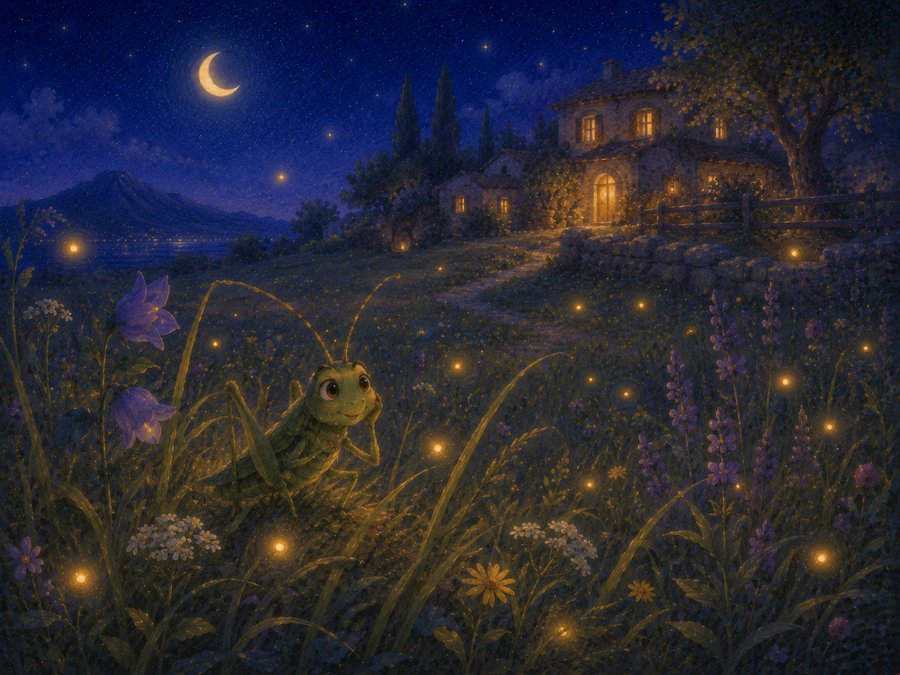
Gri was a young cricket and lived in a meadow near a farmhouse.
In the evening, when the air smelled of hay and the sky turned blue, all the crickets began to sing. Each had its own rhythm.
Cri-cri. Cri-cri-cri. Criii. Cri-cri.
Gri wanted to find the perfect rhythm.
He tried to imitate the fastest cricket. After a short while he was out of breath.
He tried the deepest one. His legs trembled.
He tried his cousin’s elegant rhythm. He got hiccups.
“I am not good,” he said, hidden under a leaf.
A snail passed by.
“Perhaps you are looking for the rhythm of the others.”
“And where do I find mine?”
“In the body.”
Gri looked at his thin legs, his wings, his belly moving quickly.
“The body does not speak.”
“It speaks softly,” said the snail.
That evening Gri did not sing at once. He climbed onto a blade of grass and listened.
He heard his heart: tic tic tic.
He heard his breath: in, out.
He heard his tired legs asking for calm.
He tried a small sound.
Cri.
He waited.
Another one.
Cri.
The rhythm was slow, but not empty. It was his.
Little by little he added a note.
Cri-cri.
Then a pause.
Cri-cri... cri.
The other crickets continued with their songs. No one covered him. In fact, his rhythm found a space among the others, like a little star among larger stars.
Gri smiled.
He was not the fastest. He was not the strongest. But he no longer ran out of breath.
In the following days he learned that the rhythm changed. When he was tired, it became slower. When he was happy, it jumped. When he was afraid, it needed pauses.
There was no right rhythm forever. There was the right rhythm to listen to that evening.
And when a smaller cricket asked him, “How do I sing well?” Gri answered:
“First, do not sing. Listen to where the body beats softly. Then begin there.”