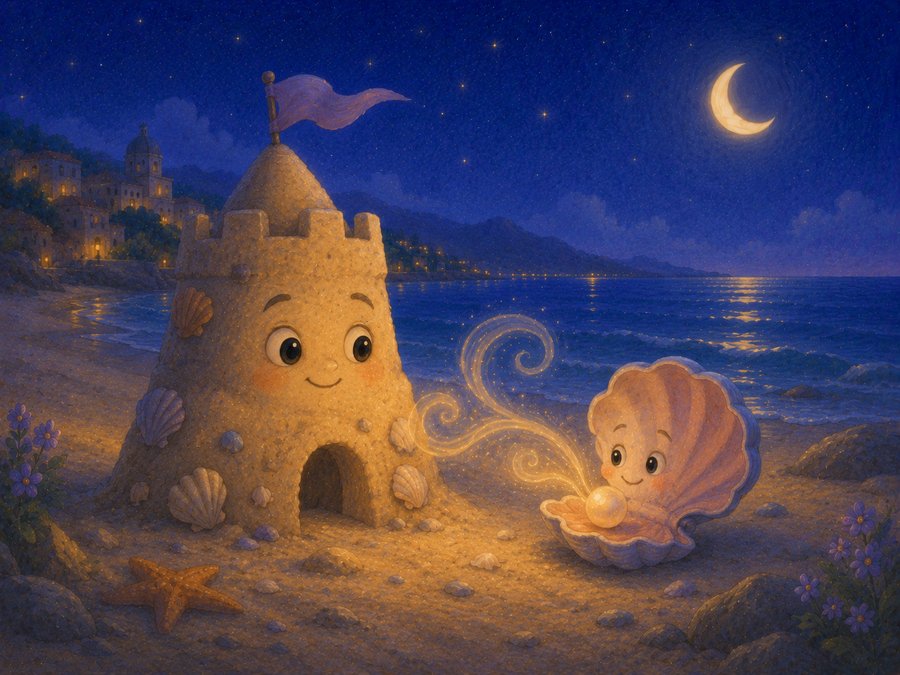
On the beach, at sunset, Milo built a sandcastle with three towers, a moat, and a white shell at the gate.
“It is the most beautiful one,” he said.
The castle, which until then had been only sand, felt important. It straightened itself as much as a sandcastle can and looked toward the sea.
The waves were coming closer.
“Do not come,” said the castle. “I must stay like this forever.”
The shell at the gate spoke in a small voice.
“No sandcastle stays the same forever.”
“Then I do not want to be a sandcastle. I want to be made of stone.”
The shell did not laugh. “Even stones change. Only more slowly.”
Milo went home with his bucket. The castle remained alone with the evening. The first wave wet the moat. The second carried away a battlement. The third softened one tower.
The castle trembled.
“I am disappearing.”
“You are returning to the sea,” said the shell.
“But Milo will not recognize me anymore.”
“He will recognize you in something else.”
The next wave lowered it again. The sand slipped, mixed with the water, and shone beneath the Moon. The castle no longer had towers, but it felt a new movement: it was shore, grain, soft road for bare feet.
The following morning Milo came back. The castle was gone. In its place he found the shell and a smooth strip of sand.
He knelt and smiled.
“Today I will build a harbour.”
The sand that had been a castle became a pier, a boat, a square, and a bridge.
Then the castle understood that changing is a little frightening, but it does not destroy beauty. The white shell remained at the centre, like a memory.
And the sea, going and coming, told the castle that no good shape is truly lost. It simply rests, waiting for the next pair of hands.