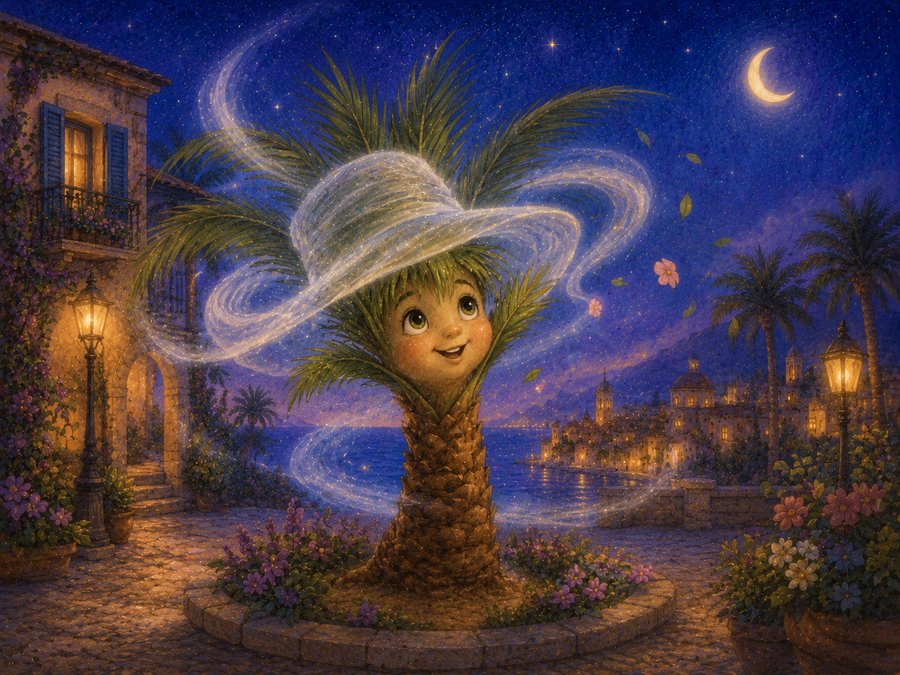
In the square in front of the sea there was a tall palm, elegant and very composed.
Every morning it kept its leaves in order. Every evening it looked at the boats and tried to seem important. The other plants teased it a little.
“Do you ever laugh?” asked the geranium.
“A palm must have dignity,” it replied.
One afternoon a cheerful wind arrived. It was not a strong wind. It was a skipping breeze, smelling of salt and lemon granita.
“I am bringing you a hat,” said the wind.
“Palms do not wear hats.”
But the wind did not listen entirely. It gathered a ribbon fallen from a stall, three bougainvillea petals, a seagull feather, and a thread of light. It spun them in the air and placed them on top of the palm.
The square fell silent.
Then a child laughed.
“Look, the palm has a hat!”
The palm grew stiff. “Take it off at once.”
The wind whispered through its leaves: “It does not make you less of a tree. It makes you closer.”
The palm looked at its reflection in the café window. It was still tall, still elegant. But now it had something funny and bright. The children were not laughing at it. They were laughing with it.
The geranium said, “It suits you.”
The palm tried to move one leaf. The breeze-hat swayed. An old man smiled. A sad little girl lifted her eyes and stopped crying.
“Did I do that?” asked the palm.
“A little you, a little the wind,” answered the geranium.
From that day on, the palm did not always wear the hat. Only on evenings when the square was too serious. It let the wind set a light detail upon it: a feather, a petal, a ribbon.
And it learned that dignity does not break when someone smiles. Sometimes it becomes more human.