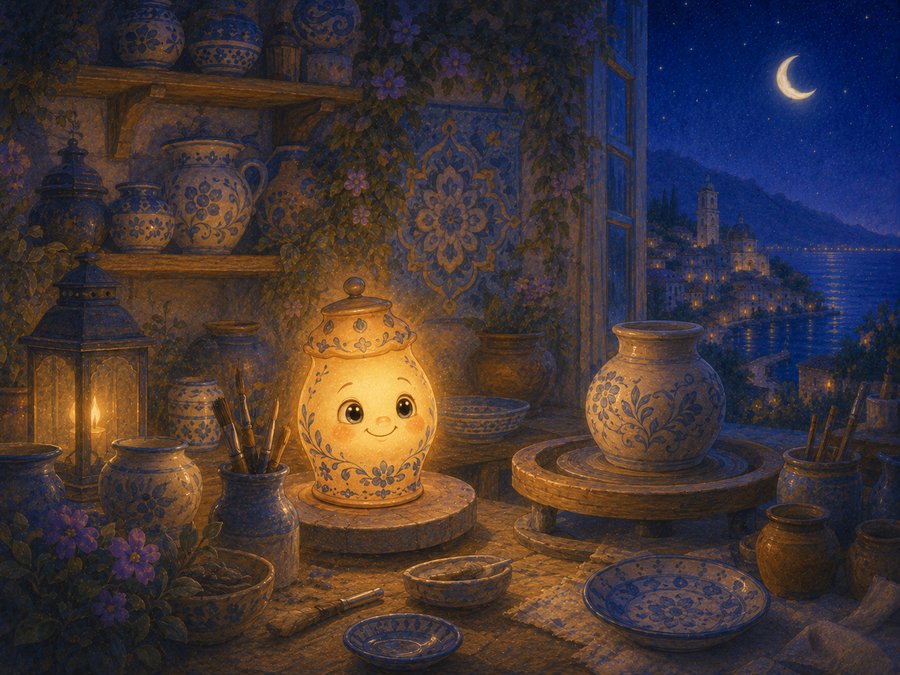
The potter’s workshop was full of plates, tiles, and painted jugs.
During the day tourists came in, children, neighbours, women with cloth bags. Everyone looked at the large colours: the yellow of lemons, the red of pomegranates, the green of leaves.
Nora, the potter’s daughter, helped with the dusting. She did it quickly, because the plates all seemed the same to her.
One evening her father forgot a small light burning on the counter. Nora returned to the workshop to fetch her notebook and saw a tiny glow moving across the tiles.
“They are not all the same,” said the little light.
Nora stopped.
The flame lit the edge of a plate. There was a blue dot, almost invisible. Then a tiny fish hidden between two waves. Then a leaf with a thin vein. Then a miniature house painted inside a curve.
“I do not see them by day,” said Nora.
“By day you look too quickly.”
The little light moved slowly, object after object. It did not illuminate everything. It chose one detail at a time.
Nora took the cloth and began dusting again. This time she did not pass over things: she met them. Every plate had a secret. Every tile had a small imperfection that made it alive.
Her father came in and found her sitting in front of a jug.
“What are you doing?”
“I am looking at the blue.”
He smiled. “Blue is patient. It shows itself to those who slow down.”
From that evening Nora no longer disliked dusting. She lit the small lamp, chose a shelf, and looked for the hidden detail.
She learned that attention is not looking at everything. It is staying with one thing long enough for it to have time to tell its story.