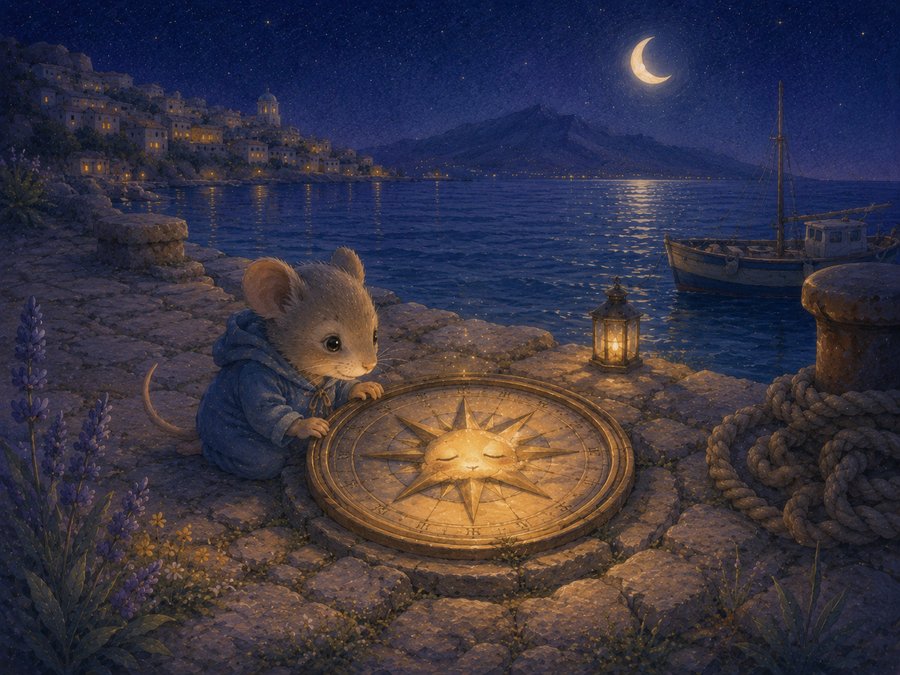
On the old pier, carved into a round stone, there was a compass rose.
It had points toward north, south, east, and west. The fishermen greeted it as they passed. The children jumped on it, trying to guess where Africa was, where Palermo was, and where the morning sun began.
Lina loved it. When she felt confused, she went to the pier and placed her feet in the centre of the rose.
“Tell me where to go,” she asked.
Usually the wind gave her an answer: a breath toward home, one toward school, one toward the beach.
One evening, however, the compass rose yawned.
Its points became misty. North and south looked the same. East curled up. West closed one eye.
“Hey!” said Lina. “I need help.”
“I am tired,” murmured the rose. “Everyone asks me for directions, but no one stops with me.”
Lina looked at the sea. She too had been turning too much that day: homework, gym, shopping, her mother’s phone calls, noises. She wanted to know immediately where to go, but she did not even know how she felt.
She sat in the centre of the rose.
“Then I will stop.”
The wind passed, but she did not get up. She smelled the salt, heard the ropes of the boats, the far cry of a seagull. Slowly her heart stopped spinning.
The compass rose opened one point.
“First direction: inside.”
Lina smiled. She had not known that inside was a direction too.
“And then?”
“Then home.”
The wind blew lightly toward the village.
Lina stood up. She did not have a great answer, but she knew the next step.
From that evening, when she was confused, she did not ask at once, “Where do I go?” First she stopped. She breathed. She listened to her body, the sea, the wind.
The compass rose was no longer only a stone for choosing roads.
It was a reminder: no compass works well if the hand that holds it trembles too much.