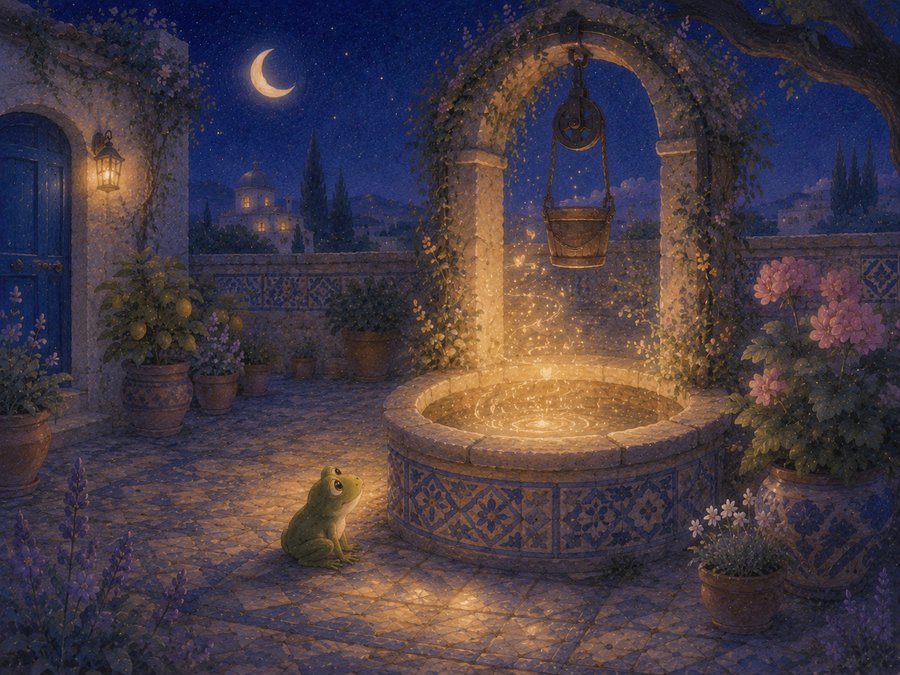
In Uncle Salvo’s courtyard there was an old well with a stone edge and blue tiles.
The children played around it, but without going too close. The well was closed by a grate, and Grandfather always said, “You look with respect.”
Pietro, however, was impatient.
“Well! Tell us a story!” he shouted one evening.
The well stayed silent.
Pietro clapped his hands on the stone.
“Tell one!”
Nothing.
His cousin Ada sat on the step.
“Perhaps it does not like being scolded.”
Pietro snorted. “It is a well.”
Ada placed a hand on the stone, gently.
“Good evening, well. Do you have a story for us?”
From the bottom came a sound: ploc.
Then a low voice, cool as water.
“A small one.”
Pietro opened his eyes wide.
The well told of a drop that had crossed the mountain, of a root that drank slowly, of a lizard that looked at its reflection without knowing it.
The voice was so thin that one had to bring silence close in order to hear it.
Pietro tried to interrupt.
“And then? And then?”
The voice disappeared.
Ada looked at him.
“Maybe heavy words fall inside and make too much noise.”
Pietro bit his lip. Then he said, “Sorry, well. Could you go on, please?”
The well began again.
This time Pietro listened until the end. He discovered that stories spoken softly are not less important. On the contrary, they ask for more attention.
In the following days he often returned to the well. If he arrived angry, the well was silent. If he spoke gently, a story came up.
They were not long stories. A leaf. A drop. A moonlit night. A frog that had lost its voice.
Pietro learned to use lighter words with people too. “Please.” “Wait.” “I’m sorry.” “May I?”
And each time it seemed to him that, inside the others, a little well found the courage to speak.